Why The Pyramid Principle Is Not A Data Storytelling Framework

Developed in the mid-1970’s by former McKinsey consultant Barbara Minto, the Pyramid Principle has become one of the most influential frameworks for structured business communication. Over the last fifty years, her framework has been widely embraced by management consulting firms and taught at leading business schools worldwide. Because of its usefulness in streamlining executive-level communications, it is often viewed as an effective format for business storytelling.
On closer examination, the Pyramid Principle was never designed for storytelling and ends up being the wrong tool for this crucial task. Before digging into why it falls short as a storytelling framework, it’s important to understand why it was created, how it works, and under which circumstances it is effective.
A Closer Look At The Pyramid Principle
Shortly after Minto joined McKinsey & Company in 1963 as its first female consultant, she was recognized for her strong writing skills and transferred to its London office in 1966 to focus on enhancing the writing skills of its European consulting team. What she discovered across the consultants wasn’t a writing problem but instead a thinking one. Too often the consultants relied on the writing process to synthesize their information, which meant executives ended up having to wade through pages of facts before understanding the main point.
Recognizing that busy executives were time-constrained, she identified the communication approach needed to shift from bottom-up to top-down. She developed the Pyramid Principle framework to focus on isolating the major and minor ideas first and then organizing them into a logical structure with the main point or conclusion at the top of the pyramid. Each main point usually has three or four key arguments, which are supported by further evidence. For the communicator, this conclusion-first approach is designed to reduce the time to create a report, sharpen its clarity, and decrease its length.
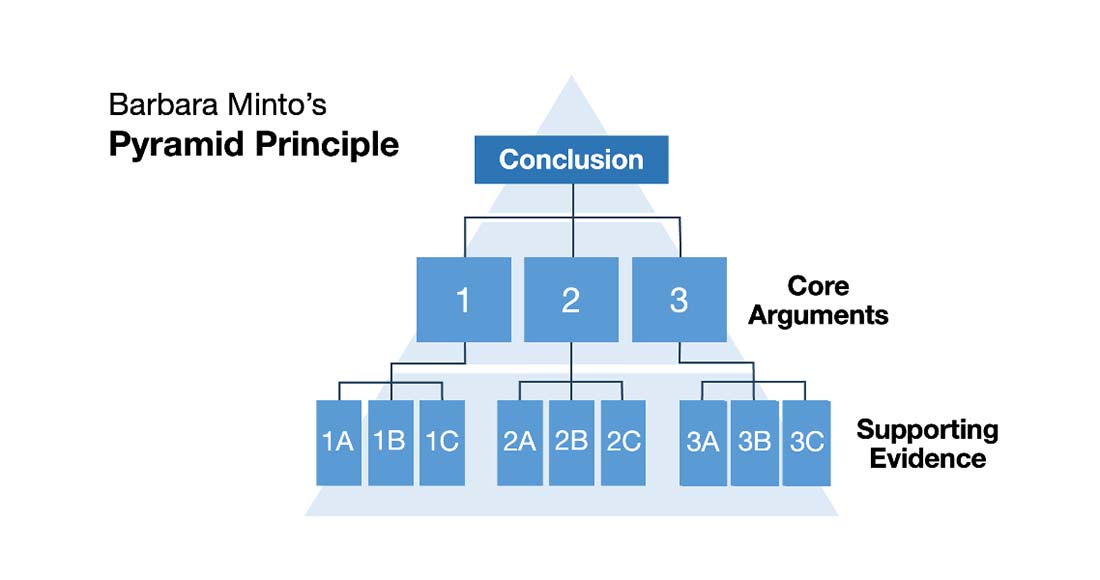
In a classic management consulting setting, this top-down approach made sense. The consultants were sharing heavily researched recommendations with C-level executives in high-trust, high-fee engagements. In the consulting projects Minto was writing for, clients already trusted the rigor and authority behind the numbers, so they didn’t need to be walked through all the evidence to believe the conclusion. The executives would only dive deeper into the details if something didn’t make sense. This type of business communication was more efficient and action-oriented, empowering leaders to focus on how to implement the recommendations.
Where the Pyramid Principle Breaks Down
Since being introduced by Minto, the Pyramid Principle and its top-down approach have become the de facto method for executive communications. Both message senders and receivers now expect communications to map to its conclusion-first structure. No one questions whether it’s suitable to every communication—brevity trumps all other considerations.
This could be seen as a huge blow to storytelling because good stories don’t begin with the answer or conclusion. They almost always follow a bottom-up approach rather than a top-down one. It would be like revealing the climax before the audience knows or cares about the story’s characters and has experienced their transformative journey. The climax would ring hollow without the buildup. When it comes to data storytelling, the climax of any data story is its main insight. Revealing the insight upfront would be efficient, but without proper set up and framing, it may not be fully understood or resonate as deeply.
Interestingly, Minto herself identified two situations where conclusion-first communications fail in her The Pyramid Principle book. After introducing them, she noted that "few of the recipients of business documents fall into either class." She assumed most executive audiences were already receptive and capable of understanding the recommended action. In her consulting context, that assumption may have held. They were:
- If the audience is going to disagree strongly with your conclusion, you must prepare them to accept it.
- If the audience is incapable of understanding the action without prior explanation, you must give them the reasoning that underlies it.

In my experience, these aren’t infrequent cases at all. In today's complex world of rich data and transformative AI, Minto's assumption rarely holds. By their very nature, insights are often counterintuitive and disruptive. Audiences are also naturally skeptical and resistant to change. And the topics and findings themselves are often multilayered and nuanced, making them difficult to process without more context and guidance. Minto’s exceptions are closer to the rule than the exception. Even though she built an off-ramp within her own framework, most have overlooked it.
To better understand these exceptions, I’ve built a 2x2 matrix with conclusion resistance and reasoning complexity on the two axes. It provides a cleaner view of how these two exceptions impact communication scenarios.

The two axes are Minto's own exceptions. Resistance represents how strongly the audience will disagree with the conclusion. Complexity represents how much reasoning the audience needs before the action makes sense. Where resistance is high, you need to build buy-in before the conclusion lands. Where complexity is high, you need to walk the audience through the reasoning before getting to the action. That leaves only one of the four quadrants aligned with Minto's conclusion-first model, which is a strikingly low ratio for a framework that has become the default for nearly all business communications.
Implicit vs. Explicit: How The Two Approaches Position The Insight
Even though Minto's Pyramid Principle is top-down, she recognized that audiences need more framing and background information before they’d accept a conclusion. Her SCQA framework tries to address this contextual gap by adding narrative-centered elements like Situation, Complication, Question, and Answer to support the pyramid. The Situation and Complication establish context and create tension. The Question focuses the audience’s attention. The Answer then resolves the tension as the top point of the pyramid.

While it bolts a hook onto the Pyramid Principle, SCQA doesn’t change the fundamental direction of the communication. The audience is still presented with the answer before seeing the supporting evidence. The framework remains primarily top-down.
This is where the Pyramid Principle diverges from data storytelling. In Minto’s framework, evidence primarily serves a validating role for an already stated conclusion. The audience is told, “Here’s the recommendation. Now let me show you why.” The efficiency comes from optionality. An executive can read the Answer, evaluate whether they agree, and stop there. They don't need to read the supporting arguments or evidence if they are happy with the recommendation.
Data storytelling follows a different path. It begins with evidence and patterns, guiding audiences toward an insight they can discover themselves. The audience connects the dots before being asked to accept a recommendation. The goal isn’t simply to communicate a conclusion efficiently. It’s to build understanding that leads naturally to that conclusion—effectiveness over just efficiency.
The difference becomes clearest when you separate two things the Pyramid Principle tends to blur: the answer and the insight. The answer is the recommendation, the course of action, or what the audience should do. On the other hand, the insight is what the data reveals and why it matters. It provides the reasoning that makes the answer the right one.
In the Pyramid Principle, the answer is explicit and the insight is implicit. The recommendation sits at the top of the pyramid. The insight lives below it, distributed across the supporting evidence, available to anyone who digs for it but never surfaced as the main point. Because the evidence is optional, an executive can accept the answer without ever deeply understanding the insight behind it. The reasoning is there, but it isn’t a required destination.
Data storytelling reverses this. The insight is the main destination. It's synthesized in front of the audience and positioned as the climax or aha moment where what the data reveals combines with why it matters. The answer is still present, but it now follows from an insight the audience has already formed in their minds. They construct the solution from the evidence rather than evaluating a conclusion handed to them. That participation in the reasoning process is what produces conviction.
When practitioners simplify Minto’s framework further into an executive summary that contains only the recommendation and supporting points, this gap widens. The audience receives the conclusion but misses the journey that makes the conclusion understandable and meaningful.
For data storytelling, that journey matters. Lasting conviction comes from helping audiences connect the dots themselves, not simply from presenting them with a readymade answer. The approach shifts the conclusion from something stated to something that feels logical and inevitable.
Pyramid Principle: Complementary But Not Interchangeable
The Pyramid Principle and data storytelling aren’t interchangeable tools. While they both demand discipline and skill, they serve different aims. The Pyramid Principle excels at organizing information so it can be consumed quickly and efficiently without having to dive into all the details. It is a great format for informing an audience.
Data storytelling is essential when you need audiences to understand what the evidence means before asking them to act. When comprehension and conviction matter more than speed, a data story will synthesize evidence to create meaning. It is a great format for deepening understanding, building buy-in, and inspiring change.
Recognizing which situation you’re in depends on whether you feel the audience already understands the insight or must discover it for themselves. When the insight is already understood, the Pyramid Principle can efficiently communicate a conclusion and course of action. When the insight still needs to be discovered, storytelling becomes essential. That’s why the Pyramid Principle is best viewed as a general communication framework—not a data storytelling framework. Data stories don't just communicate conclusions; they help audiences discover the insights behind them.

.png)
Now Available: The Effective Data Storytelling Masterclass
Based on the bestselling book, this all-inclusive course is the ultimate guide you need to learn data storytelling.


